
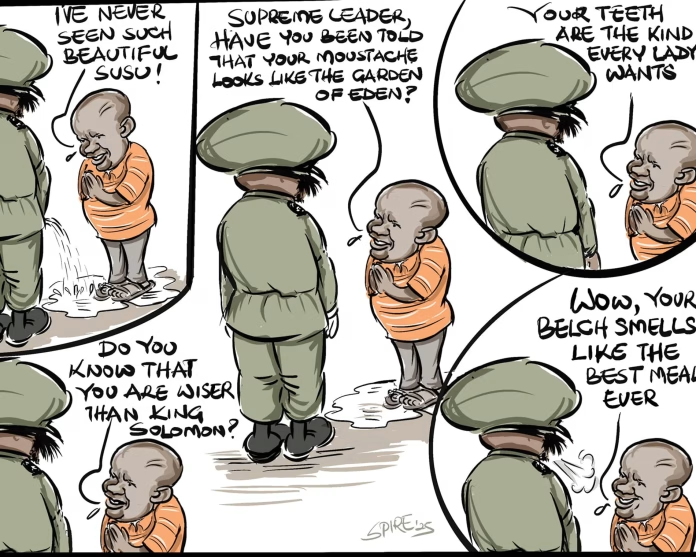


In a scathing cartoon that recently circulated on Facebook, a bulky man in a baggy green army uniform urinates on the ground. Another man, wearing sandals, stands in the puddle, admiring it.
“I’ve never seen such beautiful susu (urine),” he says.
The sycophantic man is portrayed as Balaam Ateenyi, a Ugandan government minister. The urinating figure is Gen Muhoozi Kainerugaba, head of the military and son of President Yoweri Museveni.
“Ateenyi has a habit of praising everything Kainerugaba does, even when he tweets all that nonsense,”
— Jimmy Spire Ssentongo, the cartoon’s creator
Spire used the cartoon to expose what he called the infantile nature of political praise in Uganda, where freedom of expression is often suppressed. He’s part of a growing number of cartoonists directing their satire toward Museveni’s powerful and increasingly controversial son.
Satirical Resistance Amid Authoritarianism
Cartoonists like Spire and Chrisogon Atukwasize (pen name: Ogon) are part of a tradition that stretches back to Uganda’s post-independence years. Today, they stand out as some of the few voices boldly critiquing Museveni’s authoritarian administration.
Kainerugaba, often the subject of their work, is particularly ripe for satire due to his controversial behavior and unchecked political ambition.
Kainerugaba: Heir Apparent and Online Provocateur
The 51-year-old military leader is widely believed to be Museveni’s chosen successor, despite constitutional restrictions on military involvement in politics. A graduate of Sandhurst, Kainerugaba has built a reputation for incendiary posts on X (formerly Twitter), where he issues threats, insults opposition leaders, and posts aggressive foreign policy comments.
This year alone, he has:
- Threatened to castrate opposition activist Eddie Mutwe
- Promised to behead political rival Bobi Wine
- Threatened to attack a Congolese town
In 2022, after threatening to invade Kenya, Museveni temporarily sacked him from the military. But just 15 months later, Kainerugaba returned — this time as head of Uganda’s military.
“It is really scary that a person of this calibre is getting more and more power.
What is he likely to do when he is totally in charge?”
— Jimmy Spire Ssentongo
Satire as Social Commentary
For cartoonists like Ogon, Kainerugaba is irresistible material.
“When you factor in his ambition and outrageousness, the things he does online,
it is easy to see why he’s the most dominant topic in our work.”
— Ogon, editorial cartoonist at the Daily Monitor
Ogon’s work spans democracy, governance, and human rights, but in recent years, Kainerugaba has overtaken even Museveni and opposition figure Kizza Besigye as a central figure.
In one cartoon, Ogon depicts Kainerugaba as a child graffitiing walls with slogans praising Museveni. A white man—labeled as U.S. Ambassador William Popp—asks the president:
“He’s always been like this?!?”
Museveni replies:
“Certainly. He loves me so much, he’s my avenger.”
A Long Tradition of Cartoon Resistance
Uganda’s political cartoon tradition dates back to the 1960s, though many early artists self-censored under Obote and Idi Amin. Under Museveni, repression persisted, but the regime began focusing its censorship efforts on TV, radio, and newspapers, inadvertently giving cartoonists more room to operate.
Today, cartoonists like Spire and Ogon are reclaiming political space through humor.
“Many Ugandans fear talking about certain people,”
— Spire says,
“But when they see them drawn in a cartoon, somehow it brings them down a level.”
The Power and Risk of Laughter
For Isaac Tibasiima, literature lecturer at Makerere University, cartoonists like Spire and Ogon provide more than laughs—they help society grapple with complex truths.
“The cartoonist becomes a social commentator …
in laughing at it, we are both laughing at ourselves and at the systems being critiqued.”
Through satire, these cartoonists are not only mocking power—but also mobilizing awareness, sparking public debate, and challenging fear.