
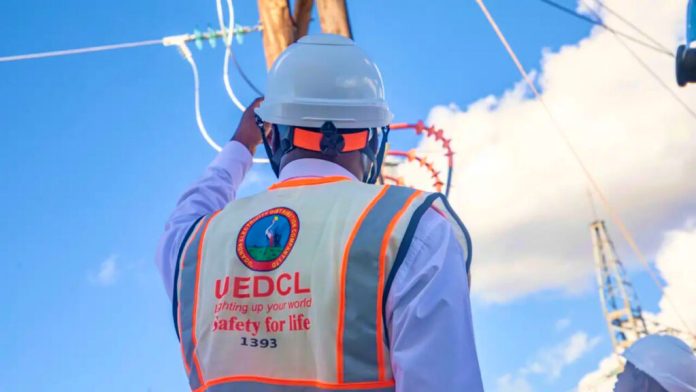


UEDCL power network upgrades are now backed by major new funding. Uganda Electricity Distribution Company Limited (UEDCL) has secured a USD 50 million loan from Absa Bank Uganda. The five-year facility amounts to about UGX 190 billion. It will support urgent improvements to the national electricity distribution system.
This comes even as UEDCL’s board investigates senior management performance. The deal was signed on December 15, 2025, at UEDCL Tower in Nakasero. Funds will go toward network reinforcements and new substations. They will also support smart-grid rollout, loss reduction, and renewable energy integration.
According to UEDCL, these upgrades will boost electricity reliability. They aim to unlock suppressed demand by the end of 2026. The investments also support Uganda’s industrialization agenda.
Notably, the financing arrives during a period of internal review. Earlier this month, the Ministry of Energy ordered a probe into issues flagged by the Electricity Regulatory Authority (ERA). Despite this, the loan shows strong market confidence in UEDCL. It reaffirms trust in its role as Uganda’s sole electricity distributor.
Board Chairperson Lydia Ochieng-Obbo called the facility “timely.” She noted the network’s long-standing need for investment after years of underfunding. She added that the deal sets a benchmark for public agencies accessing private capital responsibly. Moreover, she said it supports the government’s wider infrastructure goals.
Managing Director Paul Mwesigwa said the funds will directly improve service reliability. They will also help expand electricity access. These efforts align with national strategies for universal coverage and industrial growth.
He explained that ERA approved including the loan in the tariff framework. This move aims to make the distribution segment more self-sustaining. The facility carries an interest rate of about 8% (VAT-inclusive). That is far lower than the market average of around 28%.
David Wandera, Managing Director of Absa Bank Uganda, affirmed the bank’s commitment to infrastructure financing. He said reliable power is key to Uganda’s industrial competitiveness. The partnership, he added, aligns with Vision 2040 and National Development Plan IV.
The timing is especially critical. UEDCL took over electricity distribution on April 1, 2025. This followed the end of Umeme’s 20-year concession. Since then, it has faced major challenges.
An ERA assessment revealed an aging network. It includes tens of thousands of deteriorating wooden poles. Many transformers are overstretched. Several substations operate beyond safe capacity.
These legacy issues—combined with rising demand and deferred investment—have hurt service reliability. This has been especially true in the early months of state-run distribution.
Recently, Prime Minister Robinah Nabbanja intervened to pause any immediate staff dismissals. She urged a careful, evidence-based process. Her goal was to avoid destabilizing a sensitive sector transition.
On December 5, the Energy Ministry clarified that no staff have been fired. It described the board’s inquiry as a standard governance measure—not punishment. Energy Minister Ruth Nankabirwa dismissed rumors about bringing back a private distributor. She reaffirmed UEDCL’s mandate. She also stressed that any accountability steps will follow legal and regulatory procedures.
Amid these developments, the UEDCL power network upgrades are more than technical fixes. They represent a test of institutional resilience. With Absa’s support, UEDCL can modernize the grid while managing internal reforms. If handled well, this dual effort could build a more reliable, efficient, and inclusive power future for Uganda.