
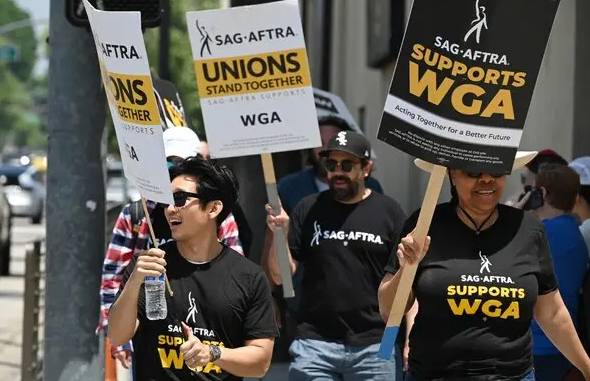


Jason Sudeikis, Susan Sarandon, and Thousands of Actors Unite for Fair Pay and Better Working Conditions
In an unprecedented move, Hollywood is currently grappling with its most significant strike in over six decades as actors rally alongside screenwriters in their fight for fair compensation, improved working conditions, and safeguards against the industry’s increasing reliance on artificial intelligence (AI). Notable names such as Jason Sudeikis, Susan Sarandon, and a multitude of other actors have pledged their support, leading to widespread disruption across the entertainment landscape.
The strike, which began in May when writers walked out, has now gained the backing of approximately 160,000 performers who have vowed not to appear in films or promote them until their demands are met. The Alliance of Motion Picture and Television Producers (AMPTP), representing studios and streaming giants, failed to reach a satisfactory agreement with the Screen Actors Guild (SAG) during talks held last week, intensifying the industrial action.
Brian Cox acclaimed lead actor on HBO’s Succession, expressed concerns over the duration of the strike, suggesting it could extend until the end of the year. Cox highlighted the shifting paradigm in the industry due to the rise of streaming platforms and the reluctance of major players to share the resulting profits with writers and performers.
Both the Writers Guild of America (WGA), which initiated the strike, and the SAG are demanding better pay, increased royalties, enhanced contributions to pension and health plans, and safeguards against the unchecked use of AI in filmmaking. Demonstrations by union members and their supporters have taken place outside the offices of major studios and streaming services in Los Angeles, New York, and other cities, garnering support from industry heavyweights.
The strike’s impact is already being felt, with major film productions like the sequels to Avatar and Gladiator potentially facing delays. Additionally, highly anticipated television shows including Stranger Things, Family Guy, and The Simpsons may experience disrupted production schedules. Red-carpet premieres, promotional interviews, and industry events such as the Emmys and Comic-Con have been halted, rescheduled, or significantly scaled back.
The root cause of the strike lies in the entertainment industry’s struggle to adapt to the digital streaming era and wider technological advancements. Both actors and writers have witnessed a decline in their earnings over recent years, as inflation erodes the value of their contracts. Actors are now forced to take on multiple roles to earn what they once made from a single role, while writers face precarious contracts that often exclude payment for revisions or new material.
Fran Drescher, the current SAG president, expressed shock at the treatment of industry professionals, stating, “We are being victimized by a very greedy entity.” The failed negotiations between the unions and the AMPTP mark the first dual strike since 1960, with the last actors’ strike occurring in 1980 and lasting ten weeks.
While the Directors Guild of America (DGA) has successfully negotiated its own contract and is not participating in the strike, it has voiced strong support for those picketing. Cinemas may face challenges as the strike potentially drags on for months, leaving viewers with limited options apart from reality TV and live sports.
President Joe Biden’s administration has shown solidarity with the workers, affirming their right to strike and expressing hope for a mutually beneficial resolution. In the United Kingdom, actors represented by Equity, SAG’s sister union, are bound by employment laws and must continue working as usual, although the union has vowed to closely monitor any attempts to shift US productions to the UK.
As the strike enters a critical phase, Hollywood is at a standstill, with the future of numerous projects hanging in the balance. The industry’s ability to address the concerns raised by actors and writers will ultimately shape the course of filmmaking and storytelling in the digital age.
For any Opinions, breaking news, Exposes, story ideas, human interest articles, or Exclusive inside Stories; email Uganda Daily at: [email protected]