
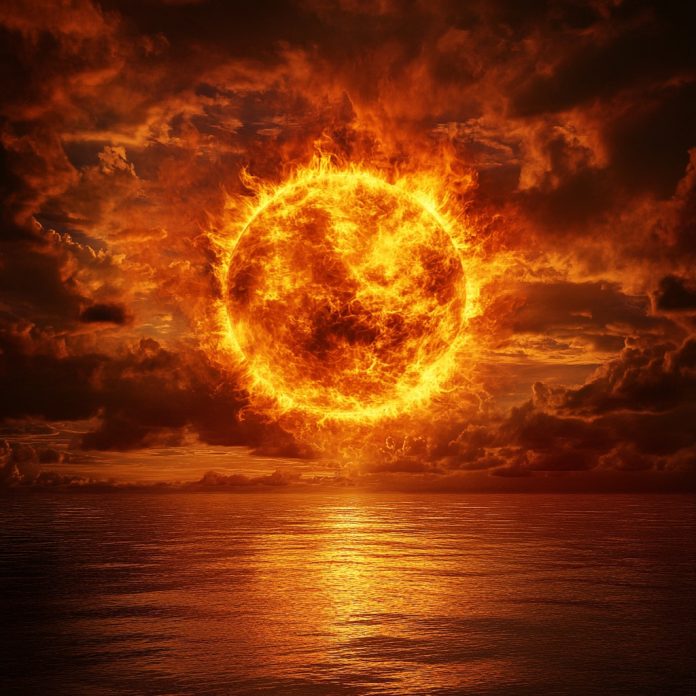


The fate of Earth and the solar system is written in the stars. As our sun evolves, it will bring about catastrophic changes that will eventually lead to the end of life on Earth as we know it. Here’s a detailed timeline of Earth’s final days and ultimate demise.
5 to 7 Billion Years From Now: The Sun Becomes a Red Giant
- The sun will exhaust its hydrogen fuel and begin burning helium, expanding to 256 times its current size.
- The transformation into a red giant will create extreme heat and radiation, profoundly affecting the inner planets, including Earth.
5 Million Years Later: Red Giant Engulfs Mercury and Venus
- The red giant’s expansion will consume Mercury and Venus.
- Earth will face extreme temperatures, causing the carbon cycle to collapse.
The Death of Earth’s Biosphere
- Carbon Dioxide Depletion:
- Extreme heat will halt carbon replenishment in the atmosphere, leading to the death of plants.
- Oxygen Collapse:
- Without oxygen-producing plants, mammals and birds will perish.
- Insect Extinction:
- Rising temperatures will wipe out the insect population.
- Microbial Survivors:
- Only microbial life forms capable of withstanding harsh conditions will persist.
- The Last Survivors – Tardigrades:
- Tardigrades, known for their resilience to extreme radiation and temperatures, will be the final living creatures on Earth.
Surface Conditions Deteriorate
- Temperatures soar to over 2,400 K (2,130°C or 3,860°F), causing violent rainstorms and intense winds.
- Earth’s atmosphere is stripped away by solar radiation.
- The surface becomes barren, composed of metals and metal oxides.
Loss of Water and Tectonic Activity
- The oceans will boil away under the intense heat, leaving behind a molten lava ocean.
- Without water, tectonic plates will cease movement, and geological activity will grind to a halt.
7.6 Billion Years From Now: Earth Engulfed
- Earth and the moon are likely to be swallowed by the red giant.
- The habitable zone shifts to the Kuiper Belt, offering new opportunities for life beyond Neptune.
A New Habitable Zone: Kuiper Belt
- As the sun expands, icy worlds in the Kuiper Belt will melt, forming liquid water.
- Neptune’s moon Triton and the dwarf planet Eris could become suitable for colonization.
- Humans might establish settlements in these distant regions, ensuring survival.
1 Quadrillion Years Later: The Sun Becomes a Black Dwarf
- The sun, having exhausted all its fuel, will collapse into a cold, dense black dwarf, about the size of Earth.
- This once vibrant star, which sustained life, will be a lifeless remnant of its former self.
The Future of Humanity
As Earth becomes uninhabitable, humanity’s survival will depend on its ability to adapt and colonize new worlds. The new habitable zones in the Kuiper Belt offer hope, but only time will tell if our species can thrive among the stars. This timeline serves as a reminder of the impermanence of our planet and the necessity to look beyond for the survival of life.