
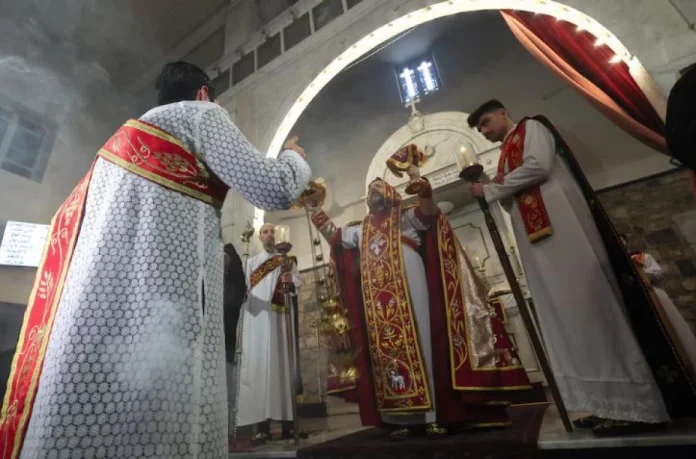


As Christmas approaches, Syria’s Christian community is gripped with a mix of fear and hope, navigating an uncertain reality under the rule of new Islamist leaders. Church leaders have urged their congregations to scale back traditional celebrations, reflecting a climate of mistrust toward Hayat Tahrir al-Sham (HTS), the Islamist group now in control. Despite assurances from HTS leader Ahmed al-Sharaa that Christians are free to practice their faith, decades of authoritarian rule and the trauma of a brutal 13-year civil war have left deep scars on Syria’s religious minorities.
A Fractured Nation Under Islamist Rule
Ahmed al-Sharaa, now the de facto ruler of Syria, leads HTS, a former al-Qaeda affiliate with a history of hostility toward minorities. Once a jihadist figure in military fatigues, Sharaa has traded his militant image for a polished one, wearing business suits and holding talks with Western officials. He has publicly vowed to avoid retribution against former regime supporters and to respect the rights of Syria’s minorities, including Christians, Alawites, and Druze. However, such promises have done little to dispel the anxiety felt by many.
For Christians, recent incidents have only heightened their fears. On December 18, unidentified gunmen attacked a Greek Orthodox church in Hama, attempting to destroy a cross and desecrating graves. While HTS authorities swiftly arrested the vandals and forced the perpetrators to apologize, the attack remains a stark reminder of the hostility Christians face. In the predominantly Christian Bab Touma neighborhood of Damascus, SUVs blaring jihadist anthems have become a disturbing presence. A chilling photograph recently circulated online, showing an armored vehicle with a message written on its windshield: “Your day is coming, Oh worshippers of the cross.”
Reluctant Optimism Amid Tension
Bishop Andrew Bahhi of St. George’s Syriac Orthodox Church has expressed cautious optimism about HTS’s response to these incidents. “The community is watching to see if the groups currently in power are genuinely committed to establishing a civil society that offers equal opportunities for all,” he said. However, he has also advised his congregation to avoid public displays of Christmas celebrations. Women have been urged to dress modestly, and the customary distribution of sweets has been restricted to church premises. “Trust is not built overnight,” Bahhi added, emphasizing the skepticism that still lingers.
The fear among Christians is not limited to HTS’s rule. The country remains a patchwork of armed factions, each with its own ideology and interests. Even as HTS attempts to project a more moderate stance, many Christians fear that underlying jihadist ideologies persist within its ranks. These suspicions are compounded by Syria’s deeply entrenched sectarian divisions and the trauma inflicted on all communities during the war.
The Weight of Trauma
The civil war has left indelible scars on Syria’s Christian community. Emilia Katarina, a resident of Hama, embodies the pain and loss experienced by so many. Her son, Firas Azar, disappeared in 2012 after being detained at a government checkpoint while planning his wedding. Two years later, her husband was killed, and she and her daughter were injured when a rebel group shelled their neighborhood. Sitting beside a portrait of her husband draped in the Syrian flag, Katarina admits that fear has become an intrinsic part of her life. “Whenever I hear a sound at night, I jump. Fear is deeply ingrained in us,” she said, her voice heavy with sorrow.
Her daughter Mary shares her mother’s apprehension, expressing skepticism toward HTS’s promises of inclusivity. “The ideology does not change in an hour,” she remarked, reflecting a sentiment echoed by many Christians who worry about the sincerity of HTS’s reassurances.
Hope in the Shadows
In an effort to build bridges, an HTS representative recently met with Christian leaders, including Bishop Bahhi, to reiterate their commitment to religious tolerance. Yet, trust remains elusive. Bahhi questioned the genuineness of the representative’s words, stating, “How truthful and serious he is? We don’t know.” For many Christians, the specter of violence looms large, and the memories of loved ones lost during the war remain a painful reminder of the fragility of peace.
In St. George’s Church, Katarina found solace in prayer during a recent sermon delivered by Bishop Bahhi on faith in times of adversity. As tears streamed down her cheeks, she lit a candle and whispered, “Maybe God will answer my prayers and bring back my son.” Her words captured the quiet resilience of Syria’s Christian community, which clings to hope even in the face of overwhelming uncertainty.
A Complex Tapestry of Minorities
Syria’s Christian community is part of a broader mosaic of ethnic and religious minorities, including Alawites, Druze, and Muslim Kurds, all of whom have faced existential threats during the civil war. For these communities, the prospect of Islamist rule has long been a source of anxiety. HTS’s rise to power has done little to ease these concerns, as the group’s history and ideology are closely associated with extremism.
The challenge for HTS and its leadership is monumental. Establishing mutual trust and fostering a sense of security for Syria’s diverse communities will require more than promises and symbolic gestures. It will demand sustained efforts to dismantle the structures of fear and suspicion that have defined Syria’s recent history.
A Long Road Ahead
As Syria’s Christians prepare for a subdued Christmas, the future remains uncertain. The scars of war, coupled with the lingering threat of extremism, cast a long shadow over their lives. Yet, amid the fear and uncertainty, there is a glimmer of hope. Leaders like Bishop Bahhi continue to advocate for dialogue and understanding, while ordinary citizens like Katarina refuse to abandon their faith in a better tomorrow.
The question now is whether HTS can rise to the challenge of governing a fractured nation and prove that their promises of inclusivity are more than just words. For Syria’s Christians, the answer to that question will determine whether their future is one of coexistence or continued fear.